Teams re-enter the same information in multiple systems.

Software integration
Connect the Systems Your Team Currently Has to Keep in Sync
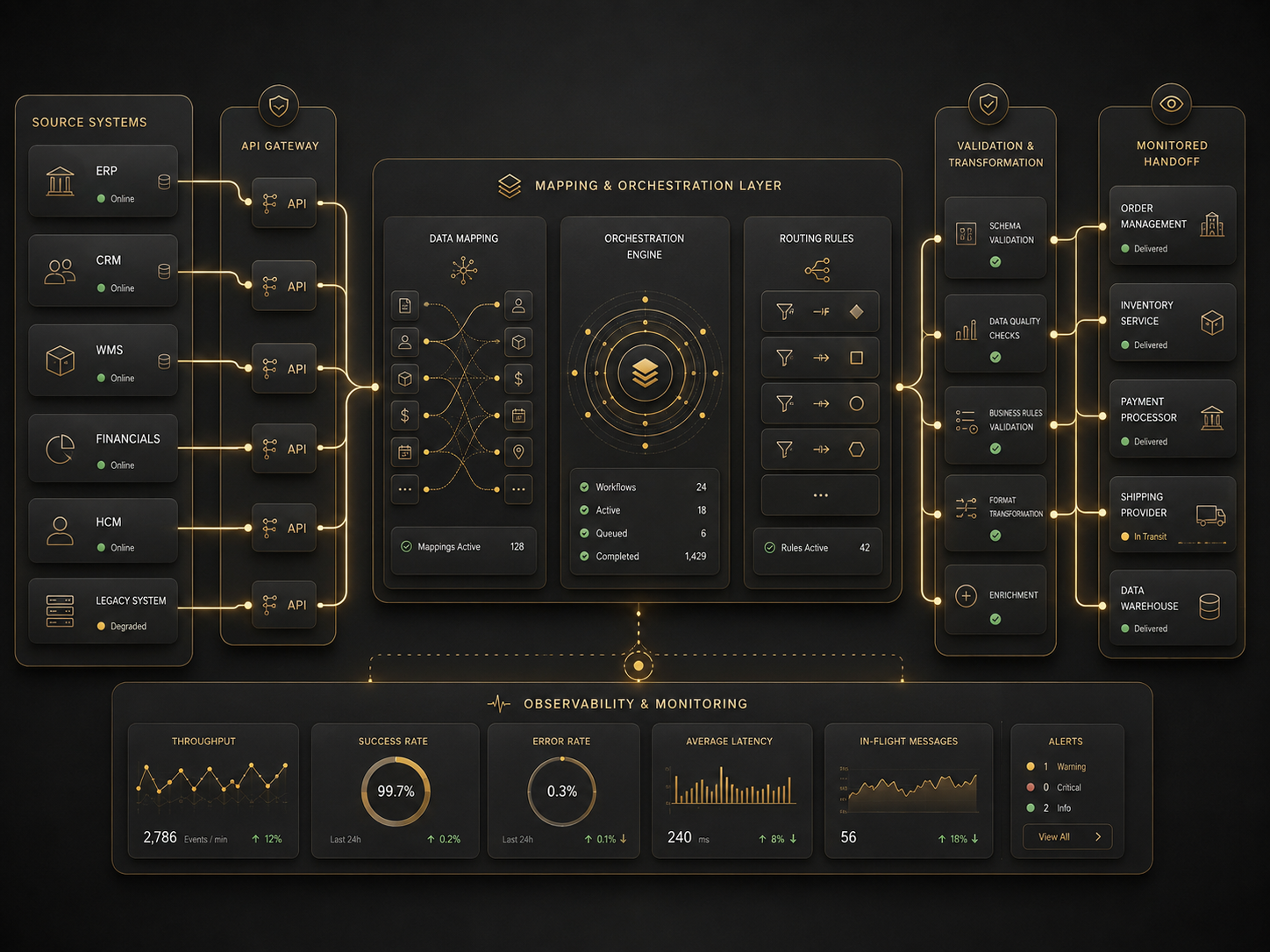
Build a bounded integration layer so information moves reliably between the applications and databases your business already uses.
Describe your workflowA legacy application and a newer platform need a reliable bridge.
Data synchronization is opaque or difficult to recover when it fails.
Relevant capabilities
What we can do
- API and database integrations
- Synchronization and data movement
- Legacy integration layers
- Monitoring, error handling, and recovery paths
Bounded project shapes
Example first engagements
- An integration assessment with clear system boundaries and failure modes.
- A fixed-scope synchronization between two operational systems.
- A replacement for a manual export/import handoff.
Where it fits
Typical systems and inputs
We establish the source of truth, responsible users, and failure paths around the systems involved in the first milestone.
Source and destination applications
APIs, files, or database access
Monitoring and recovery ownership
Operational outcome
Reliable data movement
Records are mapped, validated, and moved by defined rules rather than repeated export and re-entry.
Operational outcome
Failures are actionable
Errors are visible with enough context to correct, retry, or escalate safely.
Operational outcome
Clear responsibility
Each system has an agreed role as a source, destination, or owner of operational data.

What the first milestone leaves behind
Useful delivery evidence
The goal is a useful operational result with material your team can review, operate, and build on.
- 01Source-to-destination mapping and field rules
- 02Integration monitoring and recovery behaviour
- 03Technical documentation for support and future change
A bounded operational outcome
We identify the workflow boundary, responsible users, data involved, and what a useful delivered result must do.
Evidence before delivery
The milestone includes relevant paths, expected exceptions, validation, and handoff expectations—not just a feature list.
A useful first step
The first engagement reduces a real workload or risk; it is not a vague commitment to a large programme.
How we work
Why Brass Tracks
CTO-led planning and architecture-first decomposition.
Predictable fixed-price milestones with acceptance criteria.
Direct technical communication and clear ownership.
A controlled handoff, not a dependency on us forever.
From uncertainty to handoff
A disciplined delivery path
01
Discover
Clarify the operating problem, constraints, stakeholders, and the decision worth making.
02
Plan
Set scope, technical boundaries, acceptance criteria, responsibilities, and a fixed-price milestone.
03
Execute
Build with direct technical communication, visible progress, and disciplined review of the agreed outcome.
04
Deliver
Validate the result, provide the handoff materials, and make the next technical decision clearer.
Commercial questions
Frequently asked questions
Discuss your project
Tell us what is changing, what is getting in the way, and where you need a reliable first step.